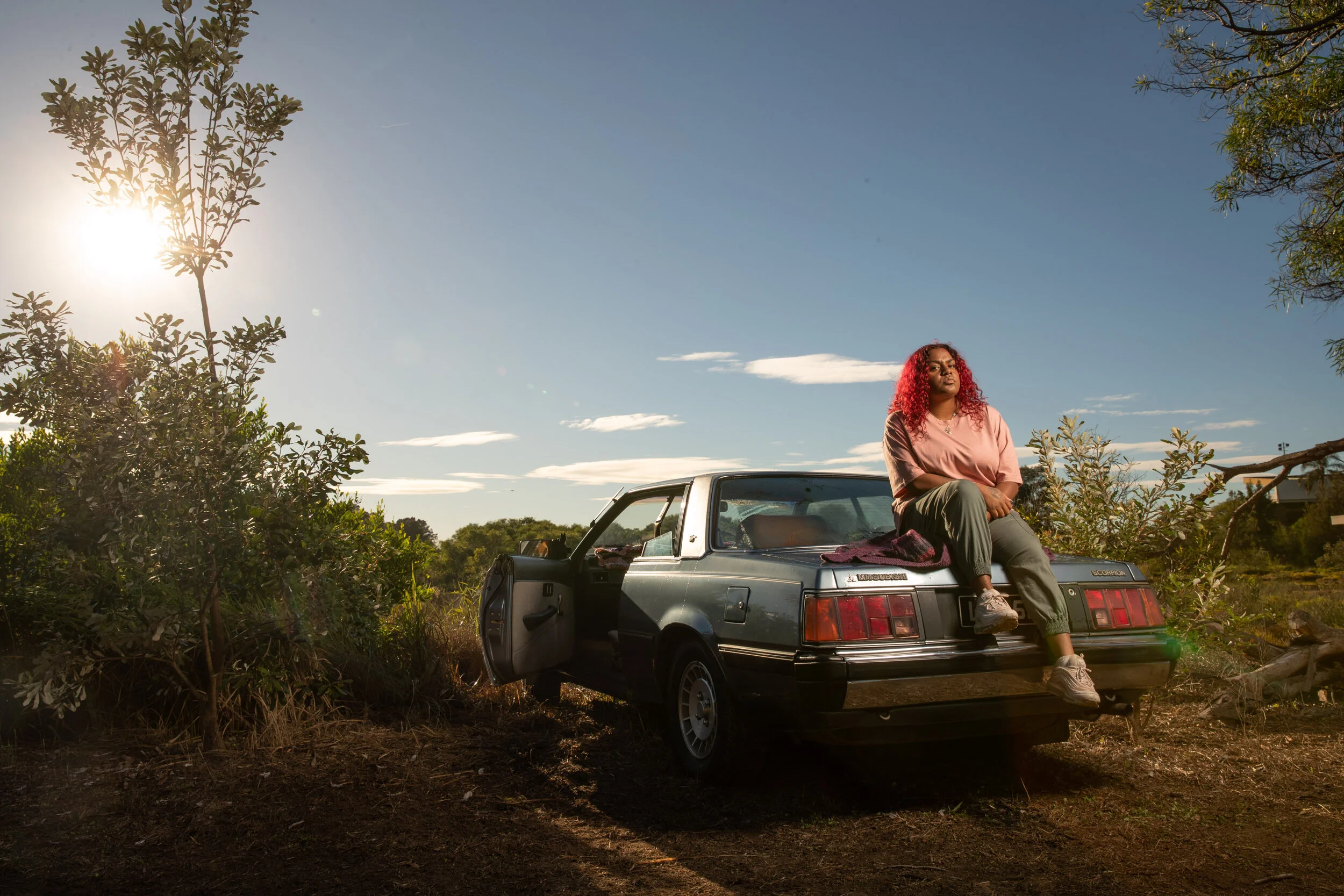
Meet Miiesha, the 22-year-old Australian singer-songwriter who makes music to honor her ancestors and challenge systems of oppression
By Chioma Nwana
All images courtesy of Cole Bennetts.
“It’s really rare that a young Black woman from the mission is given an opportunity like this.”
In the tiny town of Woorabinda—an Indigenous community in Queensland, Australia—13-year-old Miiesha enrolled in her first music program. For years, she had been an informal student of the gospel and R&B that underscored her childhood, drawing influence from the likes of musical powerhouses like Yolanda Adams, Mariah Carey, and Janet Jackson. Encouraged by her grandmother—who she often calls her Nan—she decided to nurture her penchant for music into something more tangible than just singing around her home.
Shortly after joining the program, Miiesha penned her first song, a story about a divided family. A testament to her vocal flair and lyrical prowess, the song quickly earned her an invitation to Sydney, where she performed at an event hosted by the National Aborigines and Islanders Day Observance Committee (NAIDOC).
In 2018, Miiesha decided to officially begin her career as a singer-songwriter. Limited by the scarcity of resources necessary to develop as an artist, she made the difficult decision to leave her hometown. Her family drove her almost 24 hours south of Woorabinda into New South Wales, where she settled down and began to build her catalog. She made her entrance in 2019 with her debut single “Black Privilege,” a song about the systems of oppression directly impacting Australia’s Black and Indigenous populations. She followed it up with the Queensland Music Award-winning “Drowning,” which she released in direct response to Australia’s then-Prime Minister Tony Abbott, whose apathy towards the needs of First Nations people sparked a national outrage. With just two songs out, Miiesha had become a definitive voice for disenfranchised Aboriginal Australian youth.
The following year saw her debut project, Nyaaringu—Pitjantjatjara for “what happened.” A collection of family and community history, personal anecdotes, and sociopolitical commentary, Nyaaringu became a topic of national interest, hitting the Australian Albums Top 30, winning an ARIA Music Award for Best Soul/R&B Release, and earning J Award, National Indigenous Music Award, and Australian Music Prize nominations for Album of the Year. However, the awards were not enough to subdue Miiesha’s self-doubt. Soon after the release, the trailblazing artist departed from the spotlight for almost a year. Now, in 2021, Miiesha is back. Last month, she issued her latest, “Damaged,” an emotion-filled single that simultaneously explores her broken relationship with her mother and tells the story of the devastating loss of her grandmother.
Miiesha wrote to SVGE Magazine about her new single, her grandmother’s legacy, and inadvertent activism through personal storytelling.
How are you, really?
I’m good! I’m really excited that this new music is finally getting out there. I’ve worked really hard on this, and it’s been a long time coming. It’s been a rough last couple of years for me, so I’ve really been looking forward to moving forward again. I’ve worked out [that] you’ve got to love your journey, even on days when it feels like you’re not moving forward, because it’s all part of your story.
Talk to me about the backstory of the lyrics and music video for “Damaged.”
My mother and I have a really broken relationship—my grandmother basically raised me. The song is me talking about that hurt and pain that lies between us. I’m always telling her she is damaged and needs help, and she says the same about me. Since my Nan [grandmother] passed, it’s gotten worse. It’s not good, but I will always love her. That’s my mother.
The music video is something I am really proud of. It actually has my little brother and sister, my best friend, and my aunty in it. We worked with Joey Hunter, who is amazing.
“You’ve got to love your journey, even on days when it feels like you’re not moving forward, because it’s all part of your story.”
Although the song lyrics are about you and your mother, you also managed to slip in a few subtle visual metaphors for the loss of your grandmother. Can you speak to those?
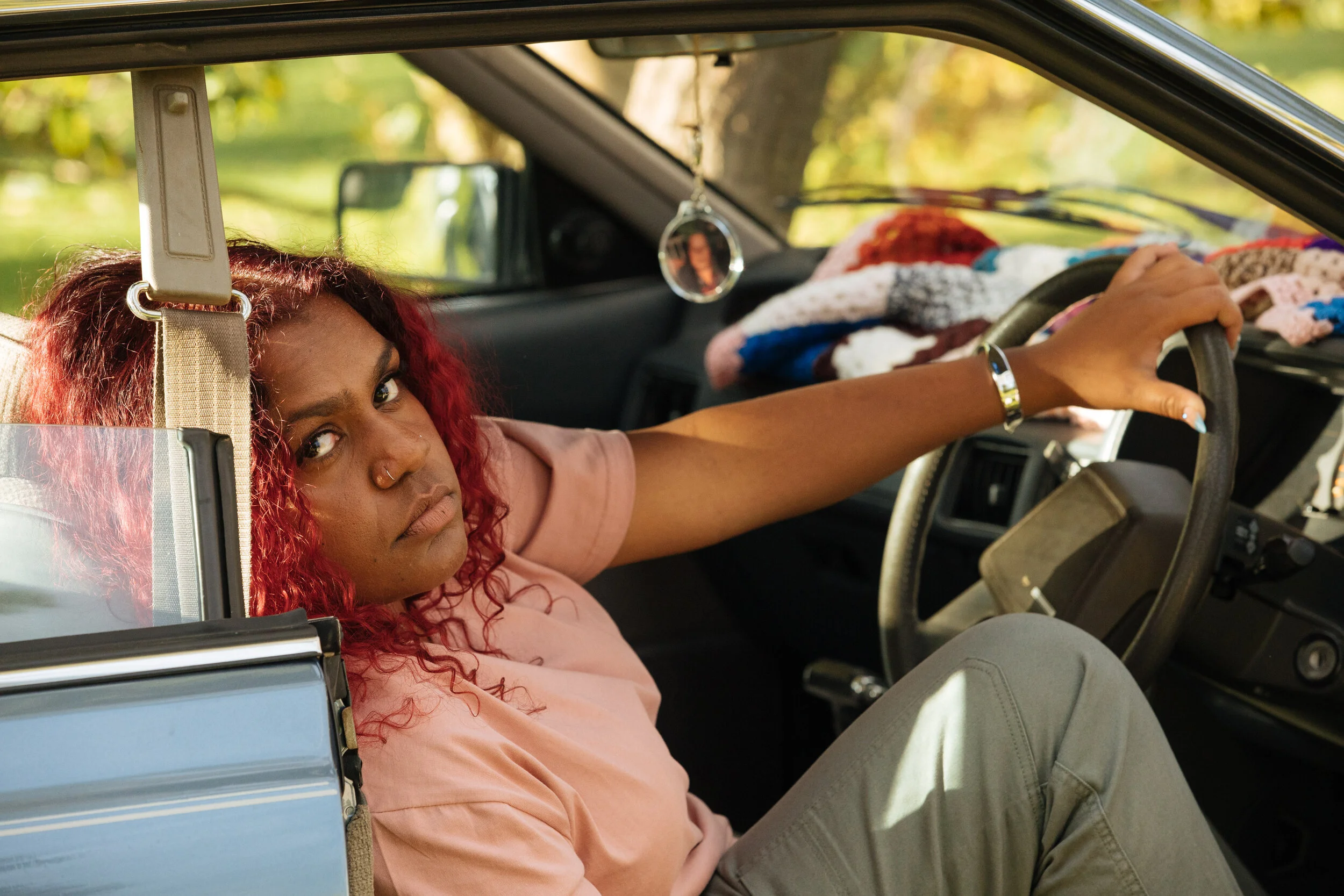
Losing my grandmother hit our family hard. It was from that pain that “Damaged” came. Because my Nan wasn’t there between us anymore, all the stuff me and my mum were going through [came] to the surface. The car in the video represents [my grandmother and the fact] that she can’t carry us forward anymore. She was so close with all her grandchildren and was always holding everything together.
I really didn’t want to let her go—and still don’t—and that’s why I’m in the car singing while the rest of the family go on their own grieving journey. At the end of the video, I leave my family behind. I will come back for them one day, but right now I need to focus on surviving this myself. There’s a photo of my Nan on the mirror, the blankets and cardigan are hers, and the number plate has her name. She’ll always be a part of my journey.
Around this time last year, you offered us your ARIA Award-winning debut, Nyaaringu. Save for a few features and song remixes, this is your first official release since then. What’s been going on behind the scenes?
I spent a lot of time back home. It was a difficult year for me—it was for a lot of people. It made me really doubt myself. It was really nice a few months ago to get back in the studio and make music videos and things again. It made me realise how much I need to be doing this. So now, I have a lot of new music coming!
Are you in a different place now than you were when you released Nyaaringu? What’s different about you?
I think I’ve started to realise how much I want to do this for the rest of my life. It’s really rare that a young Black woman from the mission is given an opportunity like this. I’ve decided I need to take every opportunity I can and use it to educate people and inspire other young kids—no matter where they’re from—that if I can do it, then they can too. It’s easy to feel like your voice and your story don’t matter when you’re from a small community, but I’m starting to realise [they do], and I want other kids to know that.
“I’ve decided I need to take every opportunity I can and use it to educate people and inspire other young kids—no matter where they’re from—that if I can do it, then they can too.”
Speaking of Nyaaringu, what was it like having your very first body of work—only preceded by a handful of singles—hit the Top 30 on the Australian Albums chart and win an ARIA Music Award for Best Soul/R&B Release?
I couldn’t really believe it! I never knew where all this would lead, so it spins me out. I’m very grateful for the support I’ve received. I feel very blessed.
Despite its popularity, the project hits close to home for you, detailing life in Woorabinda, exploring your family history, and even featuring a series of intimate audio recordings of your grandmother. Do you think there’s a reason that so many people connected with such a personal collection of songs?
My grandmother connected with everybody she met, [no matter what] background they were from. She was such a strong woman and was never afraid to speak her mind, but [she] still connected with people because she always came from a place of love. I think, maybe, her way of yarning with people has helped it connect. There’s also a lot of similarity between the stories I tell and other peoples’ [stories], even when it’s not what the song was written about. I can see how they might relate in different ways.
Thanks to songs like 2020’s “Black Privilege” and “Drowning,” you’ve become known for your contributions to discourse about the systemic oppression of Australia’s First Nations people. What is the relationship between your art and your activism?
I don’t consider myself an activist or a political artist. I’m just telling the stories I want or need to tell. It’s just my story, but because I’m Black and because of where I come from, it’s hard to not be. I cannot speak on behalf of anyone but myself—it’s not my place to—but if people feel the same and connect and relate to it, then that’s a really powerful thing, too.
In an interview with NME last year, you alluded to the fact that your music is a representation of your heritage and the legacy left behind by your ancestors. Have you ever considered that the music you’re making could be classified as cultural archival work?
No, I’d never thought about that! It’s exciting to think I could be leaving something behind for young ones to listen to and [helping to show them the way]. I hope, if nothing else, that they are inspired to follow where their heart leads them.
What else should we be expecting from you this year—music or otherwise?
I have a lot more music to come that builds on the story of “Damaged,” musically and visually. I won’t give too much away just yet, but I have finished my next project, which I’m really excited about—”Damaged” is obviously the first track. Other than that, I’ll be playing as many live shows as these times let me, and working on new stuff.
“I don’t consider myself an activist or a political artist. I’m just telling the stories I want or need to tell. It’s just my story, but because I’m Black and because of where I come from, it’s hard to not be.”