
Bona fide Harlem baby and hip-hop trailblazer 27Delly has been fly since birth
By Chioma Nwana
27Delly is a force to be reckoned with. After years of navigating the music industry on his own terms and perfecting his artist sound, the Harlem-bred rapper, producer, singer—and part-time Swahili speaker—finally delivered his highly-anticipated debut album, Fly Since Birth, last month.
Seasoned and focused, the lyricist reconnected with us, almost three years after his first SVGE Magazine interview, to discuss his project, the future of Harlem hip-hop, and his dreams of opening a global network of charter schools.
How are you doing, really?
I'm blessed, I'm happy, and I'm learning—that’s the most important one out of all of them.
What are you learning?
In terms of tangible things that other people can learn, I'm learning Swahili, which is the most frequently [spoken] language in Africa with over 150 million [speakers]. I'm also relearning how to sew. I'm making my mattress right now. I'm actually doing a whole home makeover. I'm sewing my mattress, repainting my rooms, and reorganizing my closet.
Are we to expect 27Delly home decor in the future?
When I'm like 35. I want to be a master craftsman. I don't want to be one of those people that’s like, "Oh, I just learned something new. Let me sell it." [That’s] wack. I feel like everybody's doing that right now—learning something new and automatically going to the world with it. But I'm an artist and a master craftsman. Same thing with my music: I want to take time before I just throw myself into the pit of fire. It would be in my best interest to take what I do seriously before I tell the world to take it seriously.
Can you explain to our readers what the 27 in your name means?
My father had mad “sons” because he was a leader of fashion and art culture within Harlem, but he had two biological sons: me and my older brother, ASAP Ferg.
My father’s brand name was Ferg 54—for the 54 flavors that he was gonna put out through his brand. My brother took the family name, ASAP Ferg. If my father was Ferg 54 and my brother is ASAP Ferg, it's only right that I'm 27 Delly. Also, my father once had a children's brand called Ferg 27 back in the day, so being the child brother within the family, it really made sense for me to be like, "Alright, I'm 27Delly.”
“What Harlem is doing for the culture now is me. It produced a kid like me.”
As you mentioned, your father, the late Darold “D-Ferg” Thompson, is celebrated for his impact on Harlem fashion, as well as for his logo work for two of the most influential labels in hip-hop: Uptown Records and Bad Boy Entertainment. On multiple occasions, you and Ferg have cited him as the blueprint. Which aspects of his legacy are integral to your music career?
My father had a nickname in Harlem: "The Greatest Entertainer." Outside of just designing, he threw parties and was well-known and respected in the Harlem club scene and cultural life, but the way he expressed himself was through art. Everything he did in art got catapulted because of the person he was. He was really a community leader—a community ambassador. He really took what Harlem was and elevated it to the next level with his parties, his community efforts, his leadership, his mentorship.
All of those characteristics paved the path for me and my brother. I lost my father at a young age—at five—but my brother, who's 10 years older than me, lost our father at 15. He was able to embody what he had seen our father do. I watched my brother [follow in his footsteps], and I had a small collection of memories of my father and inherent gifts within me that allowed me to be the person I am today within my community.
As a Harlem native, what does hip-hop mean to you? What role is Harlem playing in shaping the future of hip-hop?
Hip-hop is everything. My roots span further than Harlem, reaching into Sedgwick [The Bronx], which is the home of hip-hop. It's funny because I didn't even necessarily grow up on a lot of hip-hop. I was very much an oldies type of kid—I listened to a lot of The Temptations, Phyllis Hyman, Norman Connor, The Isley Brothers. But hip-hop within Harlem was swag. When I think about what Harlem really provided for hip-hop, it was style and culture. That really pushed hip-hop to another level because it was not just music—it was a lifestyle. It took over globally.
What Harlem is doing for the culture now is me. It produced a kid like me. And there are a lot of kids like me in Harlem currently, doing their own thing. I went to Harlem School of the Arts, but I wasn't the only kid that went to Harlem school of the Arts—I'm here to show that to the world.
I guess what Harlem is doing for the future is producing the ones who will shape the future of hip-hop. Harlem is a mindset—it's the heart, drive, and passion for the community. That's what makes Harlem. It’s not just a landmark. Harlem has a special energy within it that produces some special people. I just happen to be one of those people.
What is your role as one of those people?
My role is crucial because not only do I want to restore the sense of community that Harlem once had—I want to expand it. I want to take it global. I have a dream that one day, I'll be able to create a global charter school, a network of academies that stemmed from Harlem.
When I was a kid, I was taught so much of my African-American history from my grandmother and grandfather, who both changed their names legally from their former slave names to new names—Maiesha and Kweli Kanaya. [I want people to learn] about Brown and Native history of this country and realign with what's important, outside of the core curriculum. I want to create a new global standard that people can rely on and raise this country's education rank in the world. The last time I checked was several years ago—probably 2014—but I think we ranked 38th in the world.
[Given that] “the greatest country in the world” was built on the backs of Brown and Native people, it's only right that we not only relish in what our ancestors have built for us, but also expand it and show the world—outside of just being cool and jiggy—just what Brown and Native people are capable of.
I look forward to this network of charter schools.
Thank you. Not to get too crazy, but you know how white people have this sense of comfort in America—privilege? I want to create that for Brown and Native people alike.
On my neck, I have "Black privilege over Black excellence" tatted. Black excellence is a comparison of Black people’s status—it suggests that there should be privilege given to Black excellence. If everyone was born with Black “privilege” or Brown and Native “privilege,” there would actually be no need for Black excellence. I wanna push the agenda of all Brown and Native people being born excellent and not having to accomplish excellence. Not everyone is built to be a superhero, but it doesn't mean they don't deserve their flowers.
Agreed. No one should have to be a superhero or celebrity to receive accommodation. For example, a person shouldn’t have to be a genius in order to “deserve” affordable education. Everyone “deserves” affordable education.
I want to kill celebrity culture. It’s being used for capital and social gain. Classism is at its highest right now—socioeconomic classes are literally defining races. We have people who gross hundreds of millions of dollars a year and are not really doing much for the world and their communities.
A lot of them are sitting on their money.
Sitting on it. And even if they are doing something, there's really not much media or press around it—they’re doing the work, but the narrative isn't changed. What's the point of having influence if you're not gonna change the narrative? It starts in the community first. If I'm an artist from Harlem, the number one place I should be focusing my efforts is where people know me personally—that’s where I should create and establish a foundation before moving to another place. A lot of people are taught to fear home, but I never want to lose touch.
When I interviewed you in 2018, you spoke about the pressure that comes with pursuing your own music career as the younger sibling of rap superstar ASAP Ferg. You specifically said, "I want to be able to stand in the same light and not under his light." Do you think that you've accomplished this?
Honestly, yes. I can say yes with a smile. Now that I look back, I think it was always a personal thing. The only person who could have dimmed my light was me. I'm glad that I didn't allow my light to be dimmed. I stand out in a room. My brother's hitting me up and saying, "Yo, people are hitting me up about what you’re doing.” I didn't even have to tell my brother to get in tune. He had to get in tune with what was going on because it just started surrounding him.
Something special is on the way. Shoutout Sewer Sounds.
“I’m glad that I didn’t allow my light to be dimmed. I stand out in a room.”
Everything about you—your colorful style, the playfulness of your music videos, and your noble commitment to keeping lite knees and loose shoulders alive—encapsulates the essence of youth. Has music helped you to preserve your memories of growing up in Harlem?
Hell no. Music has just kept me smiling and moving. With as much positivity as I have in my life, I’ve definitely seen my fair share of negative, and music is my therapy. Aside from just talking about my problems on records—there's a time for that—most of the time, music is the mood brightener. Like, how can I curate a mood with this music that will [carry] me through my entire day?
It’s not that I don't have childhood memories. I just did a lot as a kid. I was in Harlem School of the Arts five days a week. I was playing football, going to school, being part of a family, and just being a kid at that same time—wanting to hangout. I had a jam-packed life and moved a lot: I moved from Harlem to Fishkill, then back to Harlem, and then to the Bronx. I saw so much life as a kid. It’s not that I don't want to hold onto the memories. I’m just so excited about the future that I can create with the background that I have. I use music as the fuel for the future. It’s the fire underneath my ass to get up and actually do shit. It drives me to say, "Alright, I need to learn more shit so I can talk my shit forreal.”
For example, I'm learning Swahili, so I say "poa”—it’s slang for “cool” in Swahili. In one of my records, I say "Poa, poa, I'll pour up." I’m incorporating Swahili into my raps. I’m learning a language and actually using that language in my music. Now, I'm teaching my fans, without necessarily teaching my fans. I'm not going to say, “Here's the lesson today,” but if "Poa" is your favorite song, you’re learning Swahili.
You've been working closely with Brooklyn photographer, Dani B. Reminiscent of Hype Williams' groundbreaking cinematography, Dani’s work—characterized by vibrant colors, dramatic lighting and experimental editing—captures the fullness of your personality. What is it like to work with somebody who sees you so well?
I love Dani. Dani is one of my favorite photographers—one of my favorite people. I just like the person she is. She's at the top of her game. She’s so easy to communicate with. She is such a bright light in the room. She's not afraid to express herself with her style and her words, but at the same time, she’s very level-headed and understanding. That genre of person is my favorite. Another person similar to Dani B is Kari Faux. Kari Faux gave me similar energy—on some, "I'm enjoying life and just being me" type swagger. I love that. I can't get enough of that shit. Yeah, working with Dani B. is awesome. I wouldn't trade it for the world.
Her eye is something else.
Yeah, the way she can just get it done is crazy. I remember the first time I shot with her: I was like, "Yo, what the fuck? This shit is crazy." And I didn't look back.
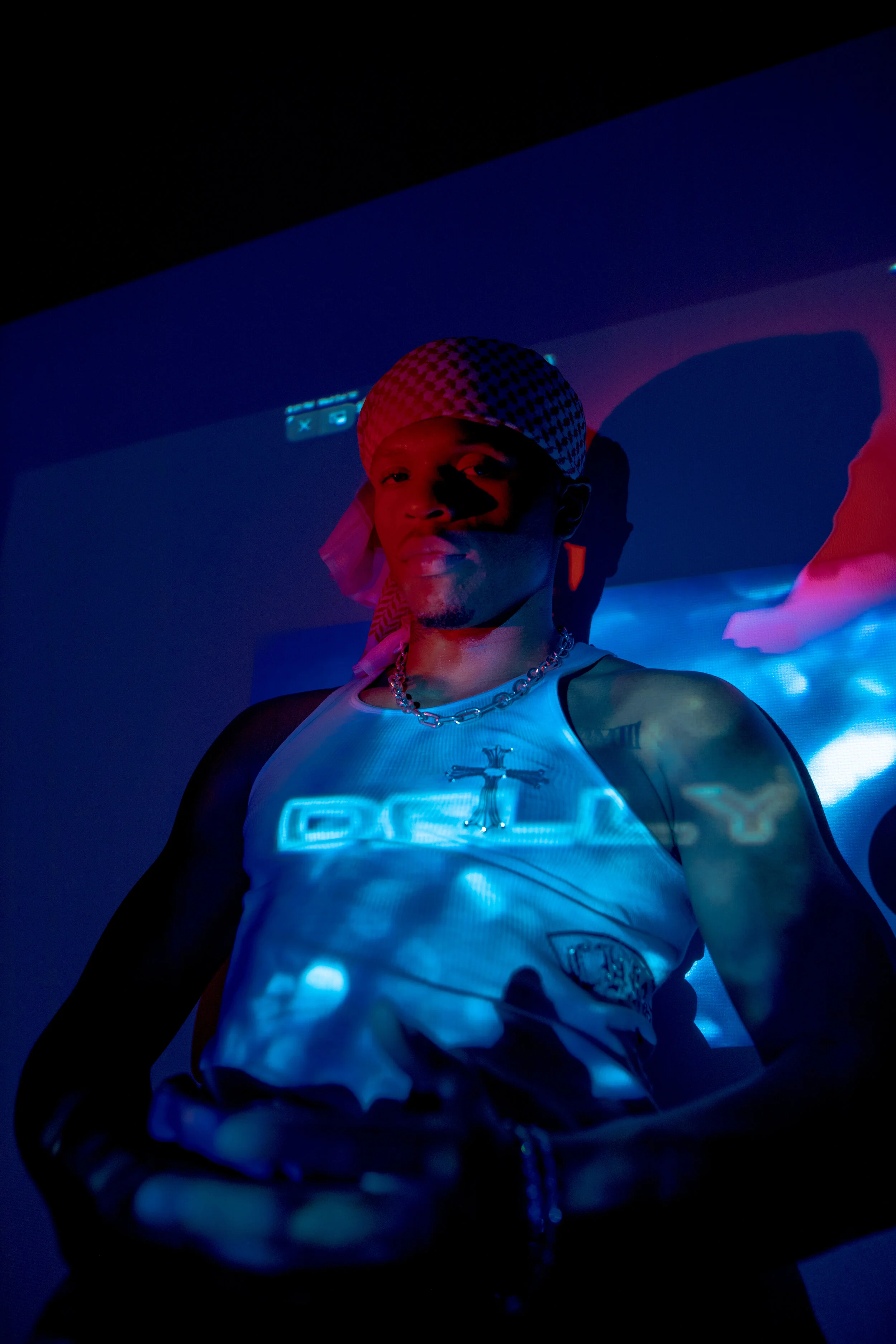
Image courtesy of Dani B.
Talk to me about Fly Since Birth, which just dropped on September 10, your 23rd birthday.
Yeah, Fly Since Birth, out now. Heatery. I don't want to be like that cocky person—I want to talk with a confident head and not a cocky head—but this is one of the best displays of swag that hip-hop has seen in a while, without the super heavy misogyny that hip-hop has. A lot of these songs are from when I first met you leading up to today. I think this is one of the best tapes that I could have put out for the culture. I would love to think of my music as the refresh button.
“This is one of the best displays of swag that hip-hop has seen in a while, without the super heavy misogyny that hip-hop has. ”
What has the reception been like so far?
Sync opportunities are at our doorsteps. Performance opportunities are pouring in. Opportunities across seas and virtual platforms have been opening up. Playlisting came in pretty early. It’s only been four days, and we’ve already made four different editorial playlists. No music videos out yet—which has been a bigger blessing—because [we want] to see the response of the audience to the music before we decide to go gung-ho on a video.
How did it feel seeing that people were so ready to jump on your project and support you?
It’s like walking out with new theme music. I feel like when someone sees me or thinks of me, they have new references to work with, directly by the source. A lot of people get moved by me through voice or heard of me through someone or heard an old record, but now they have new information directly from the source. I feel good about that.
When you and I chatted earlier this year, you had plans of dropping the project in February. What changed? What have you been up to?
It was supposed to drop in February, yeah, but [it dropped in] September. What I’ve been up to? I’ve been creating a lot more music and spreading my wings as an artist—exploring new ventures and developing the project with Ferg and Sewer Sounds. I’ve just been taking a step back, refining my work, refining my vision, and just making sure I’m putting out the best. It took a little bit longer than expected, but that probably won’t ever happen again.
As long as the time was spent making the album what you needed it to be and focusing on what mattered to you, who cares if it came out a little late?
A nigga needed to learn how to hustle. Everybody can make a bag, but making a bag towards a purpose is a little more difficult. You gotta make sure all of your chips are aligned.
I dropped this independently—it’s not like I came on a major label or a distribution situation. This is all funded by the pocket at hand. So yeah, more videos and content to come, but when you do it from the ground up and gotta do all the checks and balances with a small team, you have to be very thorough, and that takes time. It takes patience, time, and knowledge.
Is there anything that you’ve learned in the last couple months while working on this new version of Fly Since Birth that you don’t think you would have considered when you were first gearing up to release it in February?
Definitely. For example, my NFTs that I dropped. I’m seventy-five percent sold out of my NFTs. That’s been a great thing. Also, these looks with Telfar. I always had Telfar involved in my rollout, but now that they have Telfar TV and I can release music videos and content, it’s become a new outlet to disperse my music and roll it out. Also, my Juneteenth event was able to happen during that time. It’s been dope to just spend time in my community.
There have also been a bunch of small things. Even internally, the ways I’ve been thinking, feeling, and looking. Everything is falling more in pocket than if I had released it in February.
Now that you’re doing things as Delly the person and not just Delly the artist, do you think that any of the personal stuff that you’ve been doing recently shines through in this project?
I think about the intro to “Canary,” when I say “With these broken wings, I can fly.” That was inspired by this theological aspect of me. I’ve been able to develop my art because of how much I’ve been linking with people who are great at expression across different mediums.
And originally, with “Bonita,” the line was, “She be rocking Von Dutch jeans.” I was like, “That’s such a good line, I would rather give it to a Black brand than Von Dutch. So I changed it to Telfar, and that got a really good response from Telfar. They responded well and really roped me in the family, especially during New York Fashion Week.
Is there anything you want people to know about this new and improved Delly?
New York is back, Uptown is in the fucking building, and this fly jiggy shit is going to put all of this other shit to silence. Simple. I’m not even trying to get super deep with niggas right now. I’m only 23 years old now—the super deep shit is coming. But right now? I’m just trying to shut all this shit down. I’m not trying to stop niggas’ bags, but I’m trying to put things in perspective. What it is and what it’s not.
What’s next for you?
After this, I’m gonna shoot some great ass visuals. I’m taking a little move-vacation—I say move-vacation because it’s not permanent. A part-time residency in Europe. I can’t say where just yet, but I’ll go out there for a couple months, spread my wings, and get that foreign and global market tapped in. Not just Europe. Asia and Africa, too. I’m still trying to get a little more tapped in with the African side. I got a couple countries on deck, but I want to be able to roam the whole continent in peace.
“New York is back, Uptown is in the fucking building, and this fly jiggy shit is going to put all of this other shit to silence.”