
Streetwear clothing brand Bricks & Wood is Kacey Lynch's love letter to South Central
Nobody loves South Central more than Bricks & Wood founder Kacey Lynch loves South Central.
Who are you and what do you do?
I’m Kacey Lynch, owner and founder of Bricks & Wood. Based here in Los Angeles — born and raised in South Central to be exact. I do what I want.
In the streetwear industry, where competition between brands often stifles collaboration and discourages designers from supporting each other, you’ve chosen to take an alternative path. Can you explain why you created Support Your Homies and what purpose it has served since its conception?
Granted, I didn’t create the term “support your homies.” It was just me understanding that I had influence. I didn’t really identify with that before because I was such a student to the game. I was like, “Wait, people pay attention to what I say and do.” It’s not to be cocky — it’s just recognizing who I was, what I was doing, and knowing that it was impactful. People pay attention to what I do and what I like, so they’ll support what I support, too. I start posted the homies’ stuff on Instagram and created a hashtag. People copped their shit and followed their brands like, “I found it because of Kacey.” The Support Your Homies collaboration came from one of my friends, Cody, who has a brand called URLA. He sent me the graphic and said, “We should collaborate on this,” and I was like, “Yeah, let’s do it.” Turning that into apparel turned it into this whole other thing. Support Your Homies is a sub-brand. It’s not Bricks & Wood. It’s not URLA. It’s Support Your Homies. It’s something that everyone can relate to. Support Your Homies is a verb. It’s actually doing it, actually posting it, actually liking it, actually buying it, actually supporting it, actually going to events. It’s more of an action than just making a t-shirt or a hashtag. Cody didn’t have a super big platform, and neither did I. But that goes to show that when you put something meaningful out and showcase it on a real level, people can really tap into what you’re doing. It doesn’t matter how big you are. They put the Support Your Homies hoodie on GQ. We’re both kids from South Central having fun. We had a graphic, paid $150 for the graphic, got it done, and it turned into this colossal thing.
About people being individualized in this game, I grew up in the backend of the game. I saw a lot of backend stuff from my pops and from when I worked in streetwear. I realized that we can all act like we’re isolated, but we all essentially do the same shit. I wasn’t afraid to admit that me and another brand use the same blanks — we just put our logo on this one, and you put your logo on that one. People buy into what you put into it. Your story, your pictures, your effort. That’s why people buy into the brands. People need to get out of their shells and be more open. We all go through the same process. You just have this audience there, and I have this audience here. We could bring the audiences together and share this moment.
A lot of people think that success is binary. They think, “I’m either successful by myself, or I’m not successful.”
In the real success stories, no one ever did it by themselves. That’s not even a thing. There was some helping hand at some point, whether it’s a collaborative, a partnership, or someone believing in you. I don’t know where that pride comes from. Maybe it’s just them feeling themselves in the moment, but if you’re doing something that’s real and honest, it’ll always come back to you, no matter what. If it’s a pure intention behind it, it’s going to make its way. If you were humble at one point and then you get on, and you’re not humble, that means you were never humble. That means you let something else define you — you’re not in control. I don’t identify with those people.
Will Support Your Homies take different forms this year?
We’re trying to turn it into another brand and showcase it on the action level. We’re not just selling you something so that we can make profit off of it. We want to show how we really interact with our friends and people that we support. We’re definitely trying to do events and a Support Your Homies festival, bringing local brands together. We’re trying to map that out and figure out some sponsorships. Outside of that, for Bricks & Wood itself, I’m always open to collaborations. As long as it’s real and makes sense, we have something that we can bring to the table. Not just a cool design — I’ve had cool designs before, and I don’t put them out because they don’t have a story behind them. If I can’t relate it to something meaningful, then I refuse to put it out. I sat on my first ever graphic t-shirt for a year before I put it out because I couldn’t tell a story at the time. As long as it’s something meaningful, there’s always going to be collaboration on the table.
“In the real success stories, no one ever did it by themselves. ”
Image courtesy of Bricks & Wood.
Putting our money and support into our creative peers is not just an investment into the individual, but into the community and culture as a whole. How did you come to understand this so early on in your career? What, to you, is the definition of the community dollar?
I knew how important it was when I realized what I can do with my own dollar. When I first started Bricks & Wood, I had a $600 check. I took $300 of it and started making hats. I didn’t really invest well, but I realized that if I continued the cycle, it wouldn’t change anything. If I live check to check, or if I go make these hats, sell them out, and spend all my money on food and bullshit, then I’m back to where I started — then what I did meant nothing. Now people who want to buy into what you’re doing are like, “You can’t even supply your own shit,” because you spent the money. You have to discipline yourself. Understanding how to break a cycle is what made me more mindful of how I spend my money and how I supported other brands, other communities, and local restaurants. I was like, “Okay, if you’re out here everyday, taco man, selling tacos until midnight, and I keep putting money into your account, and you’re still coming, that’s showing me that I’m helping you stay in business. I’m helping you, and I’m being supplied because I enjoy eating your food.” Community, for me, is another word for convenience. You should be able to reach within your local whatever to get what you need to build. The definition of the community dollar is convenience, resourcing, and understanding that what you invest into a company can help things stay the way you like them to be. We complain all the fucking time. And I understand. Due to history, we have a right to be vocal, but just talking about it doesn’t really do shit. We gotta look in the mirror. We can’t just keep pointing the finger because the person you’re pointing the finger at is going in the opposite direction. You’re just following him and pointing the finger at him. For me, it’s just understanding that I invest into my community because I want to see change and growth. I want to see you keep doing what you’re doing, and I want you to be fulfilled when you achieve the money and acknowledgment.
Many “grassroots” brands are quick to abandon their respective communities for public acclaim. However, Bricks & Wood is truly a love letter to South Central: the more your brand grows, the more tightly it clings to roots. Why is that? Why is South Central so integral to the brand?
I truly can’t create without thinking about myself, what I’ve been through, what I’ve done, and what people have for me. A lot of it stems from South Central, Los Angeles. I’m just doing what everybody should be doing. You look at what’s around you, and you build off of that. You build off of what you have. I just grew up here. I could have grown up in Nebraska, and it would have been a Nebraskan brand. It’s just that South Central is where I’m from, where I live, what I do on a daily basis. Ninety percent of it is based here. It’s just who I am. That message, on its own, should show people. Start with yourself. Look in the mirror, look at what’s around you, then go. That’s longevity. You’re doing it for the Self and for the soul — not for the trend or because it looks cool. People tend to change and shift when things get to a certain level. I’m going to grow, but I’m trying to grow within this. I’m trying to grow us. I’m trying to show South Central how to have quality. I feel like that’s something that we lack. Being from here, I can say that about my community. We lack self-awareness, accountability, quality, and appreciation of our own shit. You have to be able to grow with the thing that you support.
In a recent interview with Dazed, Virgil Abloh made a bold statement that streetwear is definitely going to die. Of all the people who have shared their opinions on his take, you made yours pretty clear with the “VIRGIL GOT ME FUCKED UP” tees. As an ever-growing streetwear designer, did you feel any nervousness taking a stab at such a household name in fashion?
I’m from South Central. I’m never afraid of shit. I wasn’t nervous. I saw it as an opportunity to stick my chest out even more. Let’s say someone publicly makes a statement about your friend. It’s human nature to defend people you support, especially if your friend has helped the person who’s talking shit. I’m going to be honest, I’ve never been a fan of Virgil. I do have his book right here — one thing about me is that I respect the process. I respect how he put things together and the range of things that he’s done, and he’s Black. But I don’t like the work, and I don’t like the result. That’s just my own personal taste. It doesn’t mean he makes bad shit — he just doesn’t make things for me. The thing is, he was deeply rooted in streetwear with Pyrex Vision and Off-White. That was streetwear, no matter how you want to see it. Now he’s with Louis Vuitton and the white man, so he’s disrespecting the culture that put him on? It was a slap in the face. So I made a shirt that said, “VIRGIL GOT ME FUCKED UP,” because he got me fucked up. I personally felt offended. I already wasn’t rocking with him because I felt like he was a sellout. He’s been selling Black culture to Black people but not putting on for the people whatsoever. Virgil used his skin tone to identify with us, he manipulated my culture and people who I know fuck with him, he made all this money and got all this clout. If he’s going this route, then I’m going to speak up. He’s talking about something that I’m putting on for and that I’d never disrespect. That’s like me saying, “Fuck South Central. I’m over that.” If someone won’t speak on it, I’ll speak on it. I got a platform. I already had my closed opinion about him, but now it turned into a lot of subliminal disses to me. I took that personally. He got me fucked up. I didn’t say Vigril was fucked up in general. I’m talking about myself. If you put that shirt on, that statement he made got you fucked up because you feel a way about it. On top of that, it showcased the power of the culture that put him in his position. That shirt went crazy. That shirt was not a part of my plan. I had a twenty other items that I had to get out in seventeen days. That was the most untraditional, out-of-pocket, out-of-character thing I’ve ever done.
There was no promotion, no campaign, nothing.
Nothing. I did a mockup, put it on my website, sold it for dirt cheap, and said, “Here you go.” It was a little bit of backlash, here and there, from industry people. I’m like, “Man, you don’t know me, so you can’t tell me how I feel.” I’m a man enough to understand that it’s just my opinion, and I felt a way. If you feel how I feel, then this is for you. Go ahead, Virgil. You’re going to fashion week and doing Louis Vuitton, so you try to shit on streetwear, but remember where you came from. All I did was clarify that he was never us. He was looking for a way out the whole time.
“I’m from South Central. I’m never afraid of shit.”
What is your current perspective on the streetwear industry? If it’s not dying, then how is it changing? Where is it going?
That shit is not dying whatsoever. That shit is growing, rapidly. It’s a gift and curse though. It’s a gift because Black kids are becoming entrepreneurs overnight. People are moving out of their moms’ cribs and buying houses. I have a homie who had all his fucking clothes in the living room of his mom’s house. This nigga now has his own warehouse, drives a Tesla, hired his mom, and I’m pretty sure they live in a house together in the Heights. Streetwear is dying? How is it dying when I just put this shirt out ten minutes ago, and it went viral and is probably my most sold shirt in damn near the whole year? How is it dying when I keep seeing Black models from the streets in high fashion look books? Where do you think they come from? Do you think they grew up high fashion? I’m sure they didn’t. But streetwear is dying? You look at all this runway shit — these niggas are wearing hoodies, sweats, white socks, and sneakers. What is that? High fashion? Since when? Streetwear is nowhere near dead. The curse of it is that there are people doing it for the clout. I think streetwear is growing. I can’t say it’s growing with quality — I can admit that. But I can also tell you that it’s not going nowhere. This is the first time that streetwear has been on the forefront. There was always a disconnect, but now there’s collaboration. There was a Supreme and Louis Vuitton collaboration. High fashion has to pay attention to us. Trust me, they’re talking about us. They want to know what’s going on. They want to know how to be a part of this. They’re trying to figure out how they can benefit from us. But streetwear is dying?
In addition to your community support, you are fortunate in that you have an immediate family that stands behind you and your brand. What is that like?
In terms of my dad’s side and my mom’s side, it’s an even split. My dad’s side always promoted Self, promoted me being me. If I decided not to do something, they’d give their opinions, but they always supported what I did. My mom’s side was way more textbook. Go to school, get a job, get a house. Very by the book, which I understand because that’s how they grew up. They didn’t know better, to a certain degree, so when I got older, I couldn’t complain about it anymore — I just had to show them. I had to change the narrative so that when my nephews and little cousins grow up, they have a different understanding of how to become successful. It’s not just the textbook way. It’s like, “Uncle Kacey has his own company.” They might come work for me for a summer. It’s all types of ways that you can go about it when you have a different perspective. Not one person in my family has ever started their own business. Everyone has worked for somebody — everyone has worked for the white man.
What is it like being the first?
It’s challenging because you don’t get the full support. People don’t know until there are numbers involved. You gotta go through the ringer of your family looking at you like, “What are you doing?” They’re not understanding that you just did a fucking collaboration with a big brand. They don’t know that brand, they don’t know your brand. That’s the challenge. I don’t feel good about proving them wrong, to be honest. Why couldn’t they support this in the beginning? It’s challenging when you think about it on a personal level.
You would like to know that they support you, not just because you’re making money. Because then it looks like they’re supporting the fact that you’re making money rather than supporting you, the person, and your idea.
It took GQ covers and Anderson .Paak for people to take it seriously. If I’m being honest, even though they’re family, I’m still categorizing them in the same way as a random ass friend or somebody who wants to be supportive all of a sudden. It’s the same energy. Blood ain’t no thicker than water. If you’re family, you should really understand and should have really been there. Thank God I had a balance. Thank God I had my dad’s side. I would have been so jaded to success if my dad was the same as my mom.
What do you feel is your personal duty to a community that has done so much for you and your brand? Does Bricks & Wood act as a vehicle for that duty?
My duty for South Central is to showcase inspiration. Like I said earlier, I’m more inspired by the process than by the result. I don’t want you to just look at the result and think that’s success. No. Ask me questions. Bricks & Wood, the clothes are just merchandise. This is a platform. I never saw this shit as just clothes. I’ve always seen it as something that can touch real estate, non-profit organizations, the whole nine. Have I tapped into all those things yet? No, I’m still figuring it out. But I’m going to get there through the things that I have passion for, which are apparel, design, and things of that nature. When it comes to giving back to the community, I want to give back inspiration and hope. If I put a store in South Central, it’s not going to be just another store in South Central. It’s going to feel like something you would see on Melrose and Fairfax. It’s going to feel like a SoHo type of store. I’m not lowering my standard. Y’all gotta think differently. I’m willing to take that risk — if my store is slow, if people don’t want to buy because they think it’s too expensive. I did a market before in Leimert Park. I remember it being slow. People walk by, see the $40 beanie. “Oh, too expensive!” You haven’t asked me one question about the beanie — how it’s made, why it’s $40. None of that. It’s just too expensive? You buy this one black beanie, you ain’t never going to need another black beanie again in your life. My duty and my goal is to bring hope and inspiration and to get people to think. Understand that you can be from here and think differently. You don’t have to be accustomed to what the standard of your environment is. I’m going to be honest. It might sound weird to say, but I’m not just here to give back. I want you to use your mind to think and define yourself. Bricks & Wood is me being honest to the people, hoping that it inspires you to be honest with yourself. If that’s what people are getting from it, then great. I don’t do anything that I don’t support, and I don’t make anything that I don’t wear.
Image courtesy of Bricks & Wood.
There are a lot of people who make clothes but won’t wear them.
Virgil Abloh.
I have friends in fashion who said, “I didn’t see what I wanted in the store, so I made it for myself.” They literally only wear their own brands, and I love it. If you don’t wear your own brand, why should I?
I am the biggest fan of Bricks & Wood. I treat this shit like it ain’t mine. I see the future of this shit. I take pieces like, “I’m going to archive this and save it. Five years later, niggas are going to be mad that they didn’t get this.” I archive my own shit. I put them in plastics, I put them in the bins. I’m a real collector of my own shit. It ain’t even got no resale value. I want people to look at what they’re doing as high quality. I started this by looking in the mirror, looking at what was around me, and working from that. I started from myself. If you can get that message from Bricks & Wood and what I’m saying? Dope. That’s empowering you, as an individual, to continue doing what you’re doing. I’m trying to inspire people to tap in with themselves. There’s nothing I can give you that can make you do that. I can’t hand you anything to make you feel that. You have to look at something and use your mind to think deeper.
You had lived in New York for a bit. Though South Central eventually called you home, what role did your time in the concrete jungle play in your personal development and in your journey as a designer?
Everything. That shit changed my life. That was the best decision I ever made, on a personal level. Moving to New York when I shouldn’t have and wasn’t ready was the best thing I could have ever did. It put me in an uncomfortable place. I was too stagnant. I was going through the motions. I was glad something inspired me enough to take the leap of faith. It was abrupt, too. I figured it out, got a job, and the next day, I told my manager, told my family, got a spot, and I just left. From the people, from the energy, from the lifestyle, you’re either going to make it work in New York or it ain’t going to work. L.A. is different. In New York, the work you put in, you’ll get the result. L.A., you’re in practice mode until something comes your way. Unless you create your own and do something for yourself, in terms of opportunities, they come to you, and you just have to be ready. In New York, you can create your own luck, to a certain degree. I’m a very mindful person, so it wasn’t a tough adjustment. You just have to have tough skin.
You just have to jump into it.
Drop me off, and I’ll figure it out. I figured that shit out. I wasn’t even there for a full year. When I came home, this shit was all slow, not moving at all. I’m like, “Oh no, fuck that. By November, I’m going to quit my job.” My job shut down in July, but by November I had my first office. New York just put this battery in my back and showed me how to go get it. It showed me how to make my own luck. Thankfully, my goal was to be an entrepreneur, so I didn’t have to wait for an opportunity. My time spent in New York was life-changing. I didn’t even move back because I wanted to move back. I kind of had to. I was dealing with some family shit. I stayed here a little bit too long on a visit and lost the job in New York. Lease was up. I was like, “Fuck it, I might as well just stay.” I got my old job back. It kind of worked itself out. It’s funny that New York is the Concrete Jungle because during my time in New York I was shooting a lot of photos and wanted to make a coffee table book — I was going to call it “Jungle to Jungle.” The neighborhood I grew up in was called The Jungles, and of course, New York is known as the Concrete Jungle. From The Jungles to the Concrete Jungle, it was easy for me to adapt. I’m thankful that I was able to tap in. You can meet so many people in passing, at an event, walking into a store, someone coming into your store, through friends, Instagram. Besides the weather, it was easy to personally connect with New York. I think it’s because of where I’m from.
How was returning to South Central? Did you feel like you let yourself or others down? How easy was it to get back into the swing of things?
Returning was weird. I was leaving to showcase inspiration, and then I came back sooner than I expected. It was like, “Oh shit, I don’t want people to think I played them.” It was a weird situation. I was super low-key about it. I told select people and then slowly started to come out to events. It just showed me how stuck we still are. I left for New York and came back, and South Central was on the same shit. I usually get inspired by things that we don’t have, and hope was one of the things we didn’t have, besides Nip. Nipsey was the only person that was shaking and moving within South Central, point, blank, period. I was really inspired by the process. I was like, “I need to do what I can with what I have and figure out how to fill in the gaps.” That was tough because you have to find a starting point. But like I said earlier, you just have to look in the mirror. Whatever that answer is, that’s how you start. Then you figure it out.
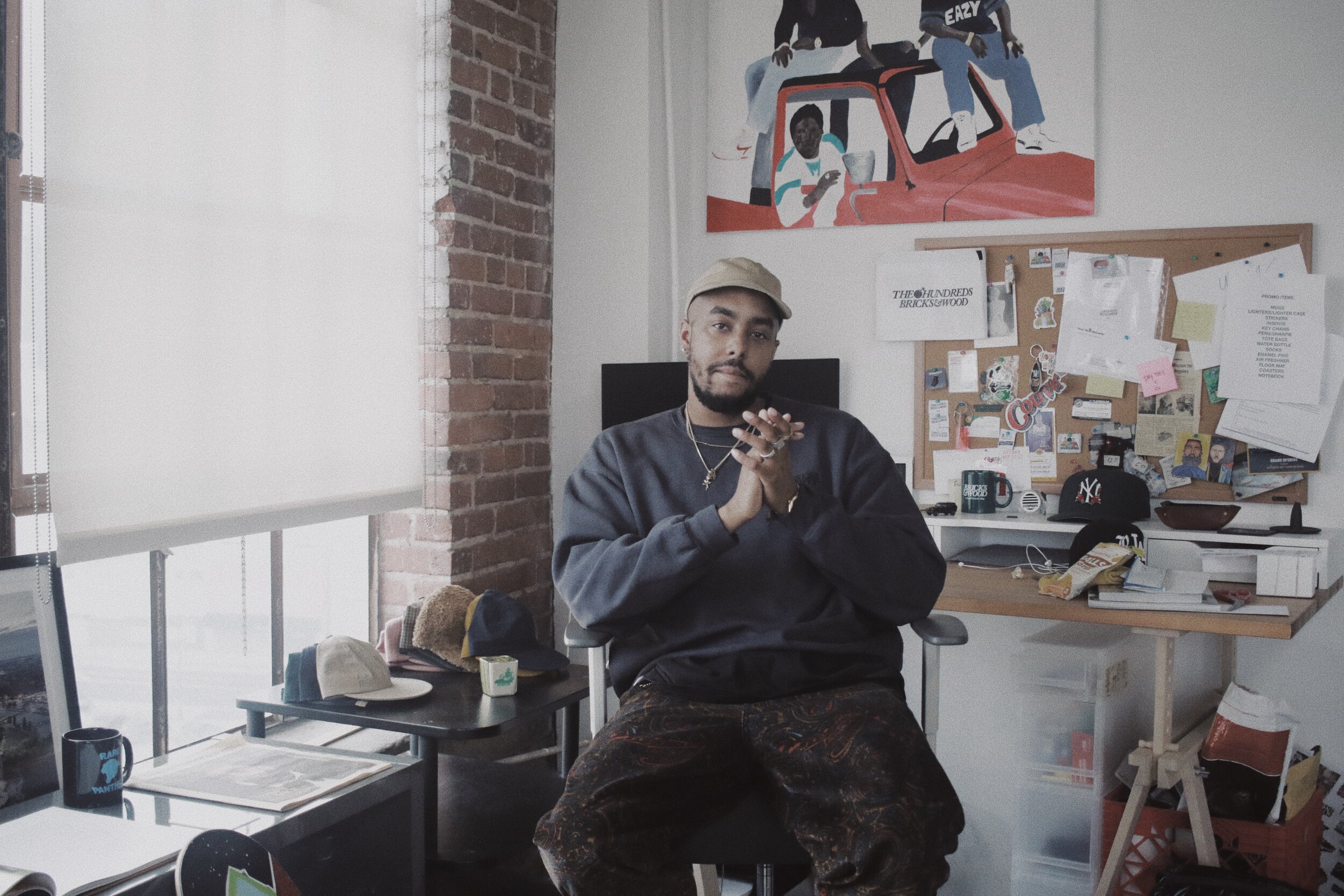
How many people are on the Bricks & Wood team currently, formally or informally? How is that working for you? Do you aspire to have a huge team? Or would you rather keep things close to the vest?
Right now, there’s me. There’s my brand operations manager, slash intern, slash mom-of-the-brand, slash first lady, Dani. She’s my first employee that I ever hired. Had another kid, Marcus. He just recently left because he moved even further away than he was originally. He was doing inventory and stock manager stuff. He was super good at that. Now, it’s just me, Dani, and my boy, Daizon, who I went to high school with. Daizon helps with marketing, photography, and campaigning. So it’s just us three and my boy, John, who does my wholesale. But John doesn’t work for me at all. He’s kind of informal. He strictly does my wholesale, but he’s also a helping hand with anything. If I need something, John is like, “I got you.” His job is literally to sell the brand to stores, but he’s like, “I’ll come in here and set the showroom up for when we have meetings. I’ll sweep.”
Do you aspire to have a large team?
Honestly, no. It’s actually super hard for me to think about another person on the team. I wish it could just be me, Dani, and Daizon doing all this shit together. Maybe one other person. John is really good at wholesale, so I would rather he just stick to wholesale and not do shit else. Daizon is good at marketing, campaigning, and photography — stick to that. Dani is good at organization, communication, coming up with ideas. That’s why she’s the brand operations manager. She’s like the creative director to a certain degree. I want people to do their job, and then I’d just get one more person who could just do inventory or stock shit perfectly. That’s all I need. I’ve already had my ups and downs with letting people go, people fucking me over. I’m trying to keep this little circle even tighter.
So you have everything that you need, and you have what works for you right now.
I feel like it’s tougher and more time-consuming to teach someone new than to learn with who you already got. You gotta learn about the person and get comfortable. There are so many different levels. The people I’m talking about, I know them on a personal level, I know them on a work level, I know them on any level. We all know how to get shit done. My goal is to come up with people who came up with me. If that’s who this team is and who it’s going to be, then ten years from now, if we’re in the office together and still doing the same shit, that’s fine by me. That’s the goal. It’s never really to open up to more people. If I have to, I will, but I strive to not do it. Honestly. That might sound fucked up because people hit me up all the time for internships, and I hate when I have to turn people down, but I try to keep it in-house.


What should up-and-coming designers keep in mind as they build their brand’s team?
You can’t teach loyalty. Loyalty comes over everything. If that person is loyal to you, whether they can do something or not, they’ll take the time to learn how to do it. I’ve seen Dani do shit out of her own willingness. Organizing the stockroom because she said, “This shit looks ugly.” It’s just certain things that I’ve seen her do to hold it down, and I was like, “That’s why you’re the best at what you do and why I love you so much. You are loyal.” I don’t care about the work you can do. If you have loyalty, we can go far. That’s the best trait you can have. That’s something that you can’t teach. You either have it or you don’t. I look around, and the people that I’m with so far, they got it. Daizon, I’ve known him since high school. We had another brand together in high school. I know his loyalty is solid. Dani, she’s shown it for the last year. I know it’s solid. John, I know it’s solid. That’s what they should focus on. You have to know who you’re dealing with on a personal level. If they don’t got certain traits that align with what you got going on, then you’re wasting your time. You just have to trust your gut, but you don’t want to let too many people in. It’s hard. There’s no right or wrong way to go about it. The only piece of advice for the question itself is to start with loyalty. Find that. If you find that somebody, then you’re making the right decision. If they fuck you over, don’t feel bad. You thought you made the right decision. You thought you believed in them and thought they believed in you. You’re learning now. You’ll start to see the signs.
“I thought that before I didn’t give a fuck, but now, I don’t give a fuck. If it ain’t nourishing or fulfilling, I’m not doing it.”
And of course, what can we expect from Bricks & Wood this year? Anything exciting that you share with us at this time?
I have nothing that I can talk about. Yeah, there are NDAs, but I also don’t want to put too much into something that might not fall through. It ain’t written in stone. The beauty of what I do is that I don’t know what the fuck I’m doing. Anything that happens — collaborations and shit — is just me being open and ready for moments to unfold. I haven’t really done too much of, “Alright, I want to do this to get this.” The only thing I really work on is myself, everyday. I work on my creativity, my process, how to be a better boss to my team.
How do you work on those things?
Holding myself accountable. When something is wrong, realizing how I could have done better. Looking at me first before I point the finger. Granted, I ain’t perfect at that. I still struggle with the finger pointing, as a Black man growing up in South Central. At the end of the day, I think the growth is the awareness. At first, that was not a thing. I would have never known these things were issues until now. I think that 2019 was a year of accountability and responsibility and understanding how to take control of who I am. I was telling my homie the other day that who I am now is who I am for the rest of my life. 26 year-old Kacey Lynch, from now until the day that day comes, it’s just going to be enhancement, but I think I’ve figured out who I am. What you see is what you get, for sure. I thought that before I didn’t give a fuck, but now, I don’t give a fuck. If it ain’t nourishing or fulfilling, I’m not doing it. This is who I am. Since I know who I am, what are the things that I don’t like that I do? Let me figure these things out. Holding myself accountable for what I’m doing. Stop pointing the finger all the time. There’s a lot more at stake now — I’m an adult, I have a brand, and I have employees around me. I have to tread lightly. The start, for me, is accountability and keeping myself in a progressive mindset by doing things that I genuinely want to do. That’s how I become better. I’m taking control and not blaming nothing else.
Image courtesy of Bricks & Wood.
--
Interview imported from SVGE Magazine Issue No. 6: The Fashion Issue (February 2020).